News page

The most recent news from our NCC.

Introducing: the HPC teaching kit (English version)

HPC teaching kit by EuroCC belgium

The HPC teaching kit is a set of documents and videos for science teachers and students. Today, we present the English version (the French version here; Dutch version will be distributed later this year). These documents can be used as support in a computer science course or distributed directly to students. The kit consists firstly of a 2-part slide deck on HPC (part 1 and part 2), highlighting examples of applications, the Belgian infrastructure, the structure of a supercomputer and the principle of parallelization. A recording of this presentation is also available on YouTube:

Part 1 Part 2


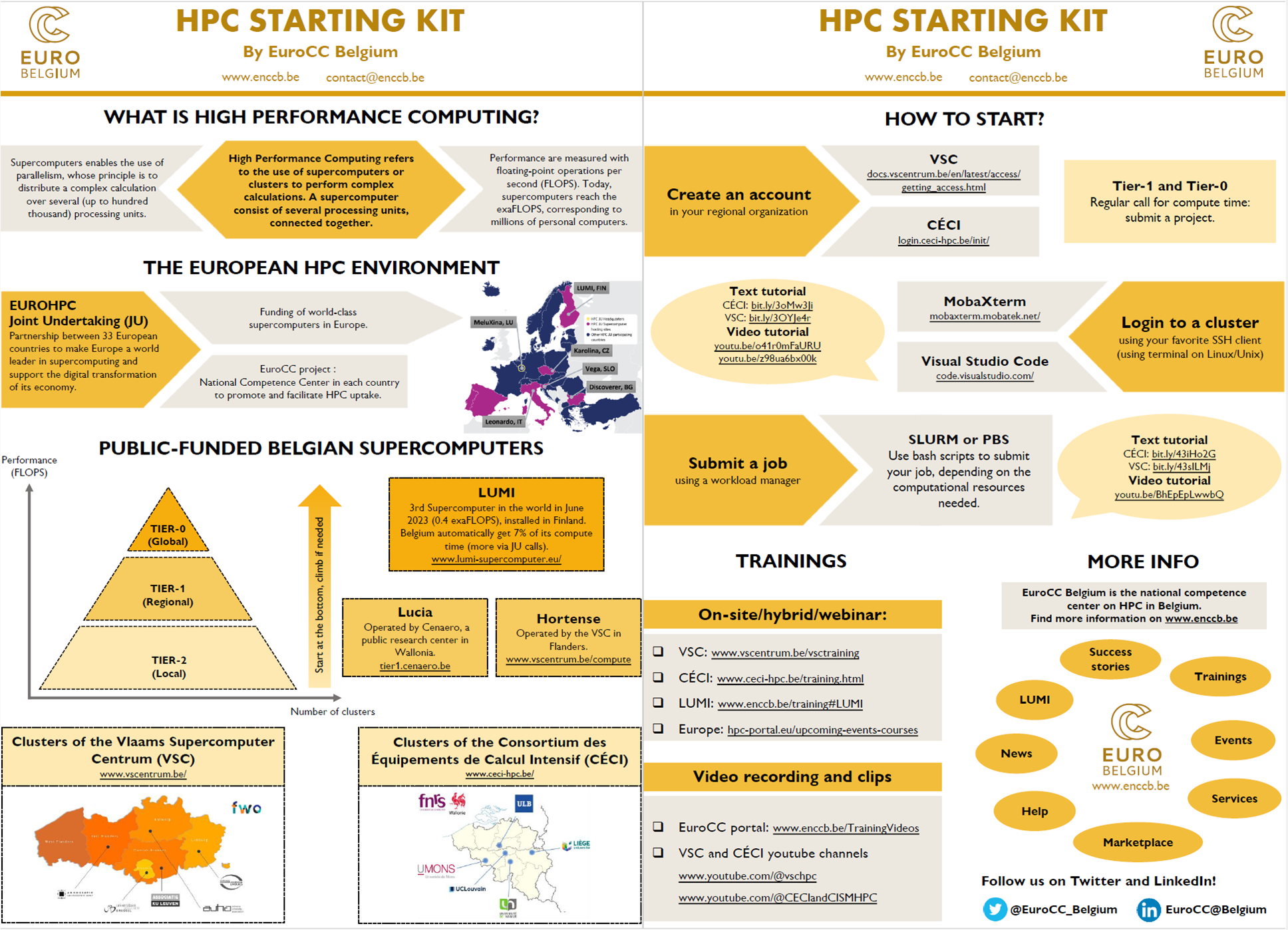
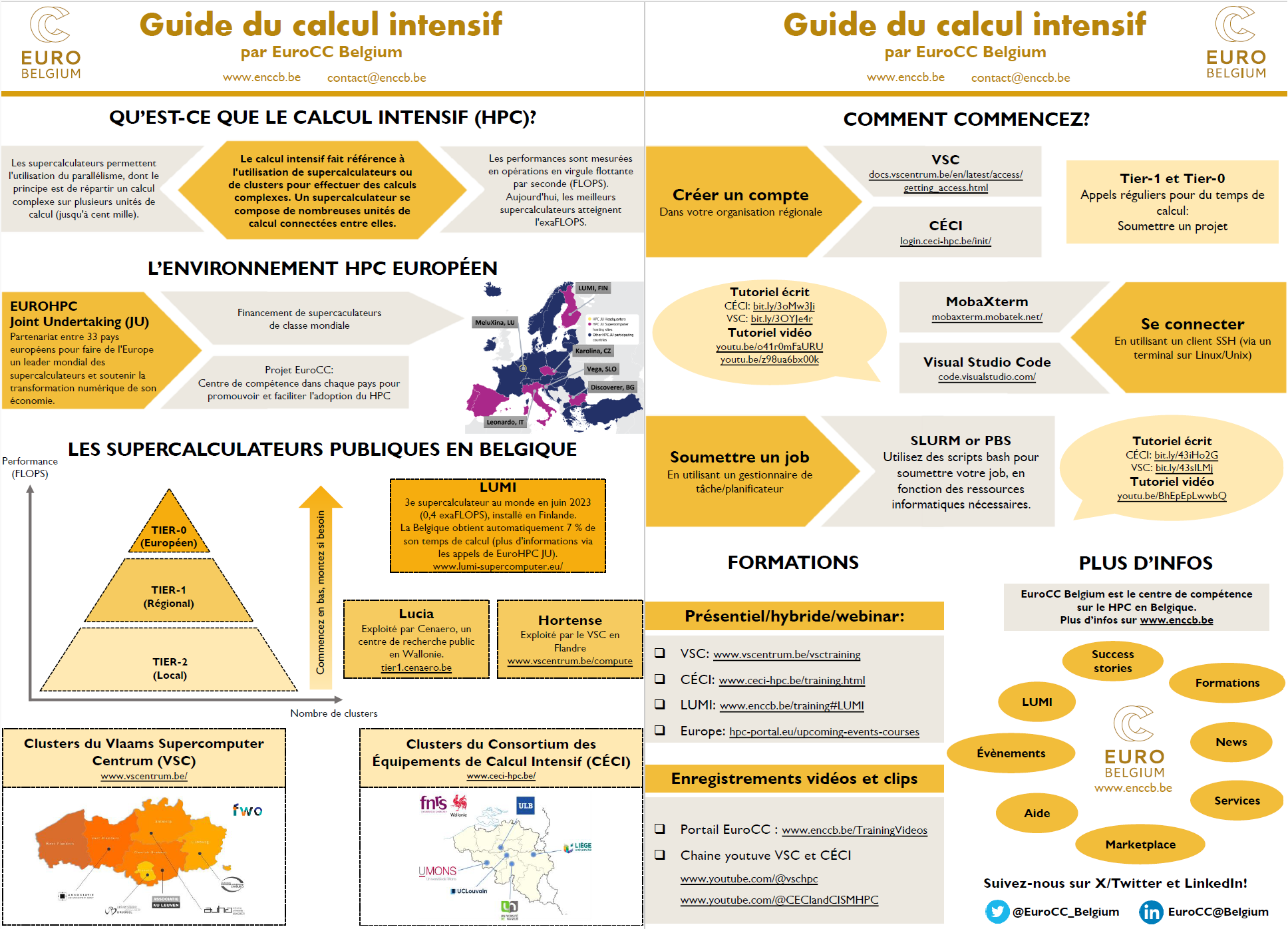
It also contains a starting kit: a 2 page document giving all the relevant information for anyone wanting to get started in HPC.

the 2 pages of the starting kit


Feel free to distribute these documents to anyone who might be interested. The PowerPoint versions of the slide deck and of the starting kit are also available, on request, for anyone wishing to modify it.


LUMI-BE User Day - 06/11/2023

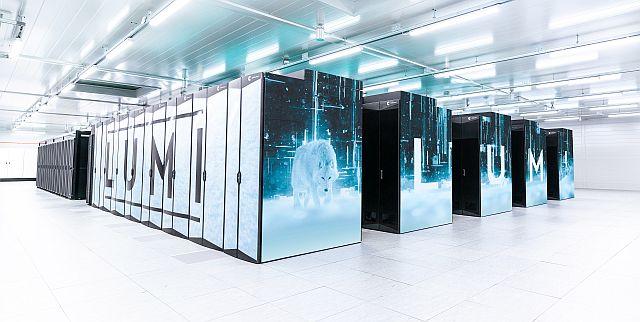
LUMI Supercomputer

Welcome to the LUMI User Day 2023!

? Mark your calendars for November 6th, 2023, as we invite you to join us for an exhilarating on-site event in the heart of Brussels.
The LUMI User Day promises to be a dynamic gathering, and we can't wait to welcome you.

? Whether you're a current LUMI user, hailing from national or international research domains, or a potential user from academia and industry, this day is designed with you in mind. LUMI bridges the gap between the possibilities of supercomputing and the innovation of tomorrow, and we want you to be a part of this transformative journey.

? Our lineup of speakers includes luminaries from the EU Ecosystem, featuring the likes of EuroHPC, PRACE, EuroCC, and, of course, LUMI.
They will share their insights, visions, and innovations that are shaping the future of supercomputing.

? But what truly sets this event apart are the voices of our users. You'll hear firsthand from researchers who have harnessed the power of LUMI and experienced a quantum leap in their work. They'll share stories of how LUMI has made a pivotal difference in their research and outcomes, and why you should consider this powerhouse for your projects.

? We also want to extend a warm invitation to the industry. LUMI is not just an academic hub; it's a platform where industry meets innovation. Discover how your organization can leverage LUMI's capabilities to push the boundaries of technology and research and accelerate your journey toward groundbreaking solutions.

Discover the full program of the event and the possibility to register for the event here.

? The LUMI User Day is not just an event; it's an opportunity to connect, collaborate, and create.

Join us on November 6th at 10 am in Brussels, as we come together to explore the limitless possibilities that LUMI offers.

Stay tuned for more updates, and prepare to be a part of something extraordinary. We can't wait to welcome you to the LUMI User Day 2023. See you there!

Introducing: the HPC teaching kit (French version)

HPC teaching kit by EuroCC belgium

The HPC teaching kit is a set of documents and videos for science teachers and students. Today, we present the french version (the dutch and english versions will be distributed later this year). These documents can be used as support in a computer science course or distributed directly to students. The kit consists firstly of a 2-part slide deck on HPC (part 1 and part 2), highlighting examples of applications, the Belgian infrastructure, the structure of a supercomputer and the principle of parallelization. A recording of this presentation is also available on Youtube:

Part 1 Part 2


It also contains a starting kit: a 2 pages document giving all the relevant information for anyone wanting to get started in HPC.

the 2 pages of the starting kit


Feel free to distribute these documents to anyone who might be interested. The powerpoint versions of the slide deck and of the starting kit are also available, on request, for anyone wishing to modify it.


Get Access to LUMI Supercomputer - Apply before 22nd of September 2023

LUMI Open call Belgian researchers 22/09/2023

LUMI is one of the pan-European pre-exascale supercomputers. It is also the fastest supercomputer in Europe (the Top500 list published in May 2023) and the third fastest globally. 

Would you like compute time on LUMI? You can apply now (deadline: 22nd of September at 23.59 h CEST). 

You can find the application form and detailed instructions at https://www.enccb.be/GettingAccess

Want to know more about LUMI and how it can boost your research?
Researcher Tim Lebailly's quest to revolutionise AI training methods led him to embrace the power of the LUMI supercomputer.
Read all about it in this EuroCC user story: https://www.enccb.be/uslumitlebailly

LUMI-Q consortium one step closer to its quantum computer

Signing hosting agreement for the quantum computer of the European LUMI-Q

The hosting agreement was officially signed for the acquisition and operation of the quantum computer of the European LUMI-Q consortium at the IT4Innovations National Supercomputing Centre in Ostrava, Czechia. The signed agreement with the EuroHPC Joint Undertaking governs the roles, rights, and obligations of the parties. The procurement process for the quantum computer will be managed directly by the EuroHPC JU and launched shortly. The investment costs for the procurement of the quantum computer are planned to amount to a maximum of EUR 7 million. They will be 50% co-financed by the EuroHPC JU budget under the Digital Europe Programme (DEP) and 50% from the contributions of the member countries of the LUMI-Q consortium.

"Signing the agreement to host the LUMI-Q quantum computer in the Czech Republic is an important milestone not only for the Czech research community in the field of quantum computers and algorithms but also represents a significant step towards developing European quantum computing resources. Together with other European partners, we are creating an important element of future scientific progress in quantum computing and its applications," said Branislav Jansik, IT4Innovations` Supercomputing Services Director and the coordinator of the LUMI-Q project.

The LUMI-Q consortium, which brings together 9 European countries: Belgium, Czechia, Denmark, Finland, Germany, the Netherlands, Norway, Poland, and Sweden aims to provide academic and industrial users with a quantum computer based on superconducting qubits with a star-shaped topology. Its advantage is that it minimises the number of so-called swap operations and thereby enables the execution of very complex quantum algorithms. The assumption is that it will contain at least 12 qubits. This quantum computer will be directly connected to the EuroHPC supercomputer KAROLINA, located at IT4Innovations in Ostrava. In addition, the plan is to connect it to other EuroHPC supercomputers, especially those hosted by other members of the LUMI-Q consortium, such as the most powerful European supercomputer LUMI, and the supercomputer Helios which will be located in Krakow, Poland.

Quantum computers have the revolutionary potential to bring a new approach to computing and solving computationally extremely complex problems. Unlike classical computers that work with binary bits, quantum computers use quantum bits (qubits) to perform parallel computations and manipulate quantum phenomena such as superposition and quantum entanglement. This gives them a unique ability to efficiently solve some problems that are too difficult for classical computers efficiently. These may include optimisation problems for solving the electronic structure of new materials or traffic and port management logistics. Several other applications are currently being developed and can be found in almost all scientific and computational domains, such as the automotive industry, the development of new electric batteries, energy, finance, pharmaceutics, quantum chemistry, cryptography, quantum machine learning and many more. Quantum computers have the potential to dramatically shape scientific research and technological development in all fields, from physics and chemistry to artificial intelligence and bioinformatics. 

Boilerplate 

The LUMI-Q consortium will provide a European-wide quantum computing environment integrated with the EuroHPC infrastructure. The proposed concept allows the integration of the targeted EuroHPC quantum computer into multiple EuroHPC supercomputers, including KAROLINA in Czechia, LUMI in Finland, and EHPCPL in Poland. The LUMI-Q consortium brings together 9 European countries: Belgium, Czechia, Denmark, Finland, Germany, the Netherlands, Norway, Poland, and Sweden.

LUMI-Q Consortium partners 

  • Coordinator: VSB – Technical University of Ostrava, IT4Innovations National Supercomputing Center, Czechia
  • CSC – IT Center for Science, Finland
  • VTT Technical Research Centre of Finland Ltd, Finland
  • Chalmers University of Technology, Sweden
  • Danish Technical University, Denmark
  • Academic Computer Centre Cyfronet AGH, Poland
  • Nicolaus Copernicus Astronomical Center, Poland
  • Nordic e-Infrastructure Collaboration,
  • Sigma2 AS, Norway
  • Simula Research Lab, Norway
  • SINTEF AS, Norway
  • Deutsches Zentrum für Luft- und Raumfahrt, Germany
  • University of Hasselt, Belgium
  • TNO Netherlands Organisation for Applied Scientific Research, the Netherlands
  • SURF BV, the Netherlands