
Unleashing AI for Drug Discovery
In our latest interview, we sat with Manon Mirgaux (ULB) and discussed how a new “competitive docking” method turns AlphaFold into a practical tool for pharma and academia
A spark that turned into a research engine
In late autumn 2024, a postdoctoral researcher in structural biology at the Université Libre de Bruxelles (ULB) had been waiting for several months for a long-awaited announcement. In May 2024, Google DeepMind had published an open-access article in Nature describing AlphaFold 3 [1], a neural network capable of predicting the structures and interactions of biomolecules with unprecedented accuracy. However, the source code and model weights were not released at that time. When Google DeepMind finally announced the open release of AlphaFold 3 on November 14, 2024 [2], everything would unfold rapidly over the following days in the Brussels office.
“Before AlphaFold’s code was open, we could only run a handful of ligands at a time,” explains Dr. Manon Mirgaux, who is now a research fellow in the Dr. Wintjens group. “That meant that our hit identification and ranking relied on black‑box docking software that was slow, imprecise, and hard to interpret.”
The opportunity sparked what would become the team’s first publication on a method they call competitive docking. It combines AlphaFold’s co‑folding power with an intuitive ranking scheme that can sift through thousands of candidate molecules in a fraction of the time and cost traditionally required.
The problem with conventional docking
For decades, drug designers have used docking—a computational technique that predicts how a small molecule fits into a protein’s binding pocket—to narrow down large chemical libraries. Classic docking programs score each ligand independently and return a single ranking list. In addition, docking scores often fail to correlate with experimental binding affinities, so many promising molecules are discarded early or costly hits are missed.
“Essentially, it’s an imperfect tool with limitations,” says Dr. Mirgaux. “Docking tells you that a ligand might bind, but it doesn't reliably tell you how much better one ligand is than another.”
Competitive docking – an elegant solution
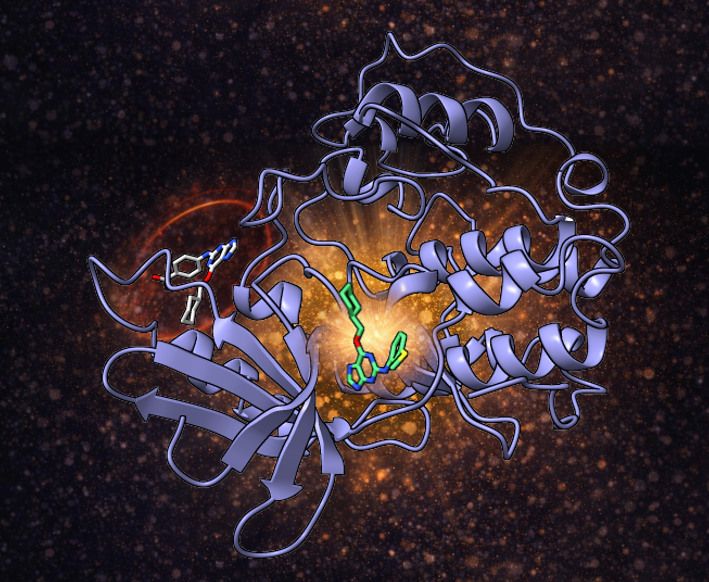
The idea was simple: dock two ligands at once and let them compete for the same binding pocket, just as players compete in a match. The method leverages AlphaFold’s ability to predict protein–ligand complexes simultaneously, producing a set of conformations that reflect how each molecule would behave when all are present together.
“Think of it like a schoolyard game where two kid gets a chance to grab the ball at the same time,” Dr. Mirgaux explains. “The children who end up holding the ball are the winners.”
Dr. Mirgaux continues: “Now imagine playing this game over and over again. The more often a child ends up with the ball, the more clearly they stand out as the best at the game.” By comparing how many times a given ligand ends up occupying the binding site across all simulations, the team can rank candidates with far greater confidence. The method is transparent: the entire pipeline—from input SMILES strings to final ranking—can be inspected and re‑run by any researcher.
In a study published in npj Drug Discovery [3], the team demonstrated this novel idea. By letting molecules compete directly for the same binding site, their competitive docking approach successfully ranked candidate compounds in agreement with experimental measurements across multiple protein targets. The method also enabled rapid virtual screening of more than 3,000 compounds and guided the design of new inhibitor candidates, highlighting its potential to accelerate early-stage drug discovery. In a second study published in the Journal of Biological Chemistry [4], the team demonstrated how AlphaFold 3 could be used beyond structure prediction to uncover the molecular preferences of an entirely new bacterial transporter. By combining AI-based modelling with structural biology and biochemical experiments, they identified the chemical features that enable copper-carrying molecules to bind the transporter, providing the first clues to how bacteria scavenge this essential metal. These results confirm that competitive docking can serve as an early filter that saves time and money before expensive wet‑lab assays begin.
Powering the method with HPC
Since AlphaFold is computationally demanding, the team quickly outgrew the capabilities of their workstation, which relied on consumer-grade GPUs. Competitive docking requires building pairwise competition matrices, meaning that every ligand must be compared against many others. As a result, even a screening campaign involving a few hundred compounds can require thousands of independent AlphaFold simulations. Thanks to the Consortium des Équipements de Calcul Intensif (CÉCI), the researchers were able to distribute these simulations across the Hercules and Lyra clusters, hosted at the Université de Namur and the Université Libre de Bruxelles.
“Each AlphaFold prediction requires access to a GPU with sufficient memory," explains Dr. Mirgaux. "On a standard workstation, only a handful of simulations can run at once. By distributing thousands of independent jobs across the CÉCI clusters, we were able to generate the complete competition matrices in a practical timeframe.”
By automating the workflow and relying on the cluster job schedulers, the team transformed what would have taken weeks on a local workstation into computations that could be completed in just a few days. Guidance from the CÉCI technical experts—particularly system administrator Frédéric Wautelet—was instrumental in adapting the workflow to the HPC infrastructure.
Open science, no patents
The team deliberately chose not to patent competitive docking; instead, they released all scripts and configuration files on Zenodo under a permissive license. Because the method relies only on publicly available tools (AlphaFold 3 and open‑source Python libraries), it can be adopted by any research group or company without licensing fees. This openness aligns perfectly with funding agencies’ priorities for reproducibility and public value.
"The AI community thrives when code is shared freely. Once AlphaFold 3 became openly available, we wanted to embrace the same philosophy by making our own method fully open."
What it means for pharma, academia, and funders
This proof of concept also demonstrates tangible return on investment in HPC infrastructure and open‑source AI research: while pharmaceutical R&D will get hit identification within weeks instead of months and increase the success rate of drug discover, academic labs will benefit from an affordable tool that can be run on existing clusters or even a single workstation with modest GPUs but also serve as an educational platform for students learning AI and drug design.
The method’s adoption could also have broader societal impact. By speeding up the discovery of new drugs, it has the potential to bring life‑saving therapies to market sooner and at lower cost—an outcome that aligns with public health priorities.
Looking ahead
The team already works on the extension of the competitive docking to more protein targets (over 20 in progress). They will benchmark against additional co‑folding models beyond AlphaFold. In addition, they see opportunities in quantum‑accelerated molecular dynamics simulations—an emerging field that promises even faster sampling of protein–ligand conformations.
A new paradigm for drug design
Competitive docking illustrates how AI can complement—and, in specific applications, outperform—traditional computational methods. It showcases the power of:
- Open source: Free access to cutting‑edge tools.
- Transparent pipelines: Clear, reproducible workflows that can be scrutinised and improved by anyone.
- High‑performance computing: Scalable infrastructure that turns large datasets into actionable insights.
“AI is not a silver bullet. But when used responsibly, it lets us ask new questions faster, test more hypotheses, and ultimately bring better medicines to patients sooner.”
Interview by E. Guillaume for EuroCC Belgium and BE-AIFA.
References:
[1] Abramson, Josh, et al. "Accurate structure prediction of biomolecular interactions with AlphaFold 3." Nature 630.8016 (2024): 493-500.
[2] A public petition from the research community led to that outcome.
[3] Mirgaux, M., Barcelli, V., Chua, A. C., Bifani, P., & Wintjens, R. (2026). AI-guided competitive docking for virtual screening and compound efficacy prediction. npj Drug Discovery, 3(1), 6.
[4] Hachmi, M., Mirgaux, M., Wintjens, R., Carassus, C., Arnoux, P., Roy, G., ... & Jacob-Dubuisson, F. (2026). A new family of TonB-dependent copper transporters linked to respiratory oxidase function. Journal of Biological Chemistry, 302(3).
https://zenodo.org/records/17795311 and https://zenodo.org/records/18173176.
(For more details on the method or to download the scripts, please visit the Zenodo repository linked above.)
AI tools used to redact this user story:
Transcription: Whisper
Grammar: ollama/gpt-oss:20B